
Please note that the product colour may appear slightly different when seen in person.
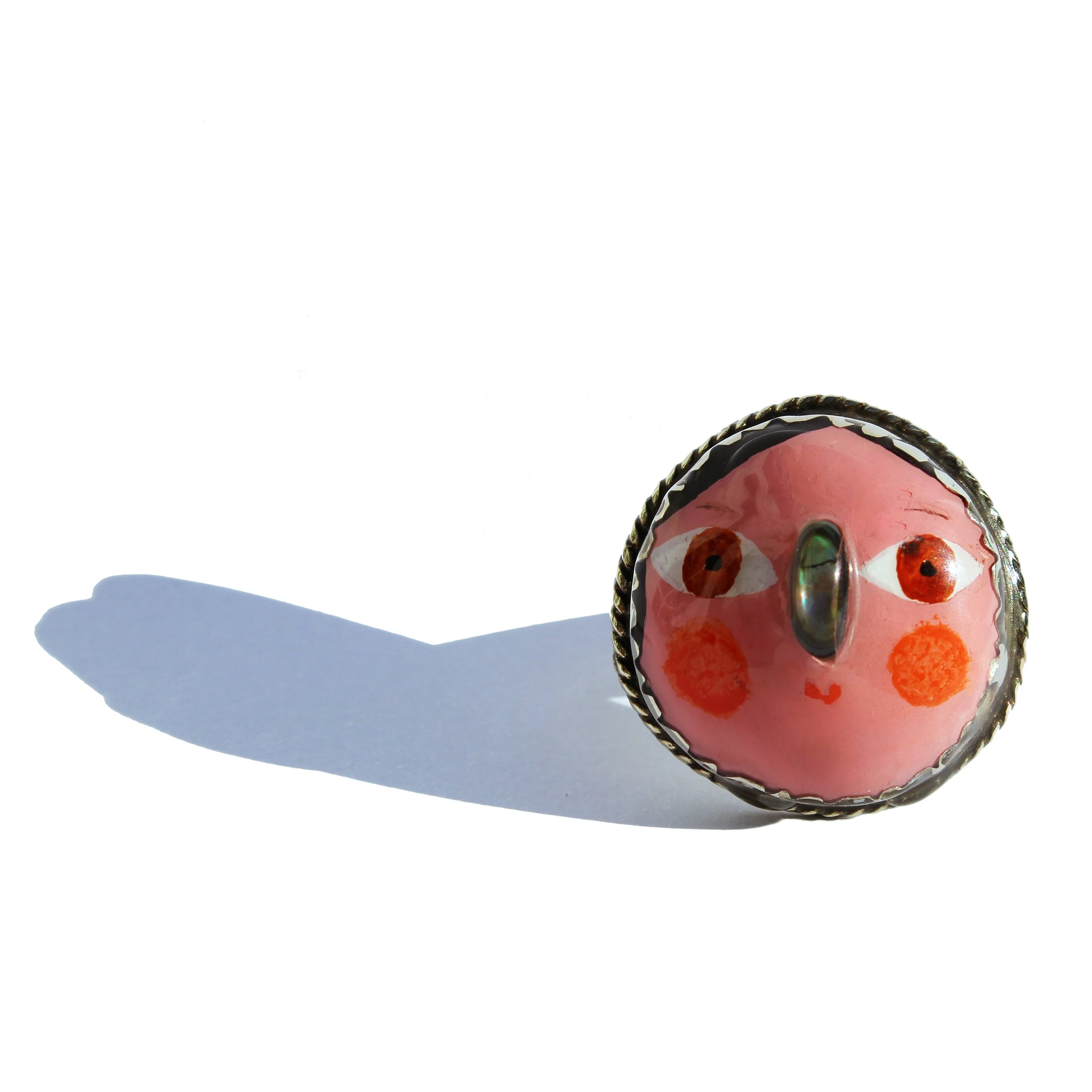
This delightful round Muñeca doll ring is painted in a soft pink reminiscent of the distinctive traditional skin tones of las muñecas de cartón. A one-of-a-kind piece, it has been lovingly hand-modelled, hand-painted, and set with a tiny iridescentblack mother of pearl nose. The miniature face is carefully encapsulated in resin and mounted on a recycled German silver adjustable ring.
Dimensions:
• Face: approximately 2.5 cm in diameter
• Ring size: adjustable
A brief history of las muñecas de cartón:
It is said that Mexican cardboard dolls originated between the late nineteenth and early twentieth centuries, during a time when European porcelain dolls were an unattainable luxury for most people. In response, Mexican families began to use their ingenuity to bring their own dolls to life, using simple materials such as paper, paste, and their imagination and colour!. It was in the city of Celaya, Guanajuato, that this tradition flourished; there, in courtyards and kitchens, artisan hands shaped figures that were far more than toys; they were reflections of Mexican popular identity.
Each cardboard doll told a story: creativity in the face of scarcity, beauty found in everyday life, and the pride of creating something with one’s own hands.
✸ Please note that the product colour may appear slightly different when seen in person.
This delightful round Muñeca doll ring is painted in a soft pink reminiscent of the distinctive traditional skin tones of las muñecas de cartón. A one-of-a-kind piece, it has been lovingly hand-modelled, hand-painted, and set with a tiny iridescentblack mother of pearl nose. The miniature face is carefully encapsulated in resin and mounted on a recycled German silver adjustable ring.
Dimensions:
• Face: approximately 2.5 cm in diameter
• Ring size: adjustable
A brief history of las muñecas de cartón:
It is said that Mexican cardboard dolls originated between the late nineteenth and early twentieth centuries, during a time when European porcelain dolls were an unattainable luxury for most people. In response, Mexican families began to use their ingenuity to bring their own dolls to life, using simple materials such as paper, paste, and their imagination and colour!. It was in the city of Celaya, Guanajuato, that this tradition flourished; there, in courtyards and kitchens, artisan hands shaped figures that were far more than toys; they were reflections of Mexican popular identity.
Each cardboard doll told a story: creativity in the face of scarcity, beauty found in everyday life, and the pride of creating something with one’s own hands.
✸ Please note that the product colour may appear slightly different when seen in person.
Please note that the product colour may appear slightly different when seen in person.